Successful cattle guard installation depends on four things: a guard rated for the heaviest truck that will cross it, a base that will not settle or wash out, a drained pit beneath, and welded wings that tie it into the fence so cattle cannot walk around. Most cattle guard failures trace back to one of those.
A cattle guard lets you drive through a fence line without stopping to open and close a gate, and on a working ranch that convenience adds up fast. It works because cattle avoid stepping onto a grid of pipes with open gaps beneath them. But the guard only keeps working if it stays level, stays clear underneath and holds up to the traffic crossing it. Across the ranch country west and north of Fort Worth, where county roads, pasture lanes and gas well access roads all see heavy trucks, we repair a lot of guards that were installed without enough thought about base or load. This guide covers how to install one properly and how to fix the ones that are already in the ground.
Key takeaways
- Size the load rating to the heaviest vehicle that will ever cross, not the pickup you drive every day.
- A concrete base or well-built footing beats ties or bare dirt for long-term stability.
- The pit under the guard needs drainage and an easy way to clean it out.
- Wings welded or bolted to the guard and tied into the fence keep cattle from walking around the ends.
- Horses can be injured on cattle guards. Put a gate beside every guard.
How does a cattle guard work?
A cattle guard is a grid of pipes, rails or bars set across a road opening in a fence, with a space beneath. Cattle see the gaps and the uncertain footing and refuse to cross, while vehicle tires roll right over. It is a behavioral barrier, not a physical wall, which is why details matter. If the pit fills with dirt, the gaps disappear and cattle walk across. If the guard is too short in the direction of travel, some animals will try to jump it.
Common designs
- Pipe guards. Round pipe, often recycled oilfield tubing, welded across steel crossbeams. Common on Texas ranches and easy to repair.
- Flat bar or rail guards. Heavier bars or rail welded to beams, often used where traffic is heavy.
- Prefabricated guards. Manufactured units with published load ratings, set on a prepared base.
- Box or boxed guards. Guards with a welded steel frame that forms its own pit walls, useful where a concrete pit is impractical.
Choosing the right size and load rating
Width and length
The guard should be wider than the widest vehicle that will use the road, with enough room for trucks to cross without dropping a wheel off the edge. In the direction of travel, ranch guards are commonly built somewhere in the range of 6 to 8 feet so cattle are not tempted to jump. If you run equipment wider than the guard, like a hay rake or a shredder, plan a gate beside it.
Load rating
Load is where many homemade guards fall short. A guard built for pickups and stock trailers may be fine on a back pasture lane but will bend under a loaded feed truck, gravel truck, fuel truck or the heavy traffic that serves gas well pads around the Barnett Shale. Manufactured guards are often rated to recognized highway loading standards, such as HS-20, and come with documentation. For a custom-built guard, the pipe size, wall thickness, crossbeam size and spacing all determine capacity. When in doubt, build heavier, and for any guard on a public road or that sees commercial traffic, have the design checked by someone qualified.
Speed matters as much as weight. A loaded truck that hits a guard fast, especially with a bump at the approach, delivers an impact far beyond its static weight. Smooth, level approaches on both sides and a sign or habit of slowing down at the guard do as much for weld life as heavier pipe. If drivers routinely bounce across your guard, fix the approaches before you blame the steel.
What makes a good cattle guard base?
The base is the most overlooked part of the job, and it is the reason most guards end up rocking, tilted or sunk at one end.
Concrete footings and pit walls
A concrete footing along each side of the opening, or a full concrete pit with walls and a floor, gives the guard a solid, level bearing that will not shift. The guard rests on the footings, often with steel angle or embedded plate where it bears, and can be bolted or welded down. This is the most durable option, and it also keeps the pit walls from caving in.
Railroad ties and timber bases
Ties are cheaper and faster, and they are common on ranch lanes. Over time they rot, especially in wet ground, and the guard settles unevenly. They can work for light traffic if they sit on a compacted, well-drained base, but expect to reset them eventually.
Steel frame bases
A welded steel base frame or box guard spreads the load over a wider area and keeps the pit sides defined. It is a good choice where concrete trucks cannot reach or the guard might be moved later.
Drainage and cleanout
Whatever the base, water has to leave the pit. A guard set in a low spot or across a natural drainage path fills with silt in the first heavy rain and stops working. Grade the approach so runoff moves past the guard rather than into it, and give the pit an outlet on the downhill side where possible. Many builders make one section of the guard removable or leave access so the pit can be cleaned out with a shovel or a small loader.
What are the steps in cattle guard installation?
Every site is a little different, but the sequence on our ranch and farm welding jobs usually runs like this.
- Pick the spot. Choose firm, well-drained ground on a straight approach. Avoid low spots, curves and steep grades.
- Locate utilities. Call Texas811 before any excavation so buried lines are marked.
- Excavate the pit and footings. Dig to the depth the design calls for, with room for drainage and cleanout.
- Build the base. Pour concrete footings or pit walls, or set ties or a steel frame on compacted base.
- Set and level the guard. Place the guard, check it for level, and anchor it to the base.
- Weld the wings. Fit wing panels at each end and tie them into the fence line, usually with pipe fence sections welded in place.
- Build the approaches. Backfill and compact both sides so vehicles roll onto the guard smoothly without a bump that hammers the welds.
- Hang a side gate. Add a gate next to the guard for horses, livestock moves and oversize equipment.
Wings and fence tie-in
Wings are angled or straight panels at each end of the guard that stop cattle from slipping around the edge. They are commonly built from the same pipe as the fence, welded to the guard frame or to dedicated posts, and then welded into the adjoining fence. For tips on fence joints and materials, see our guide to pipe fence welding for ranches.
Common cattle guard problems and repairs
Because guards cannot be hauled anywhere, every repair is field work, which is exactly what our rig is built for.
Broken welds
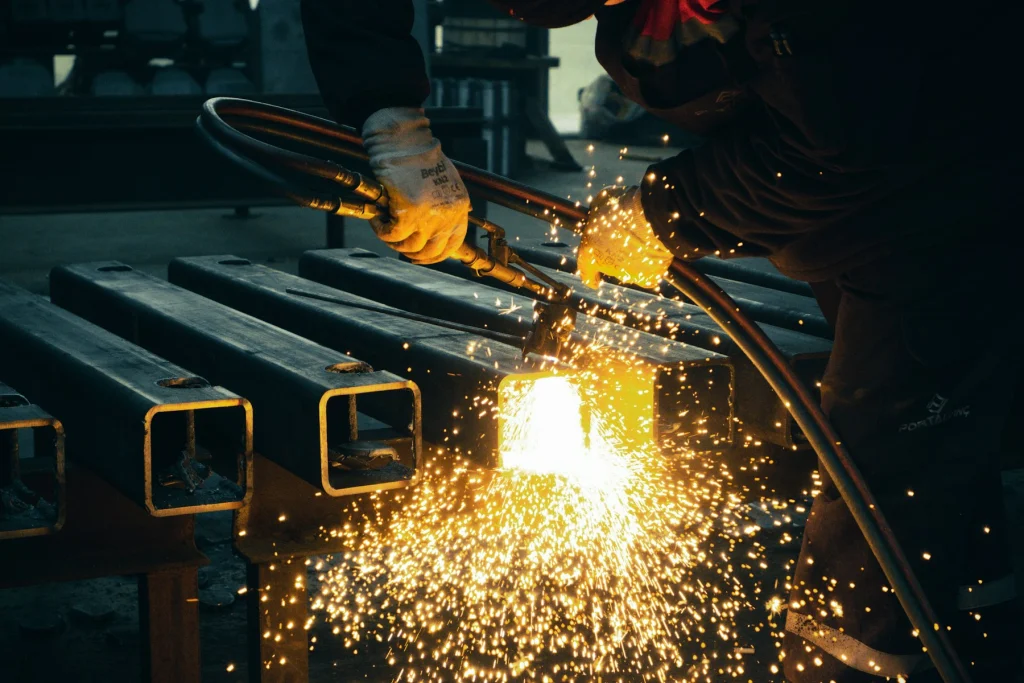
Pipes or bars break loose from the crossbeams after years of trucks pounding across them. A loose pipe rattles, and then it shifts, and eventually it can roll or pop out. We grind out the old weld, check the pipe and beam for cracks, and weld it back with full fusion around the joint.
Bent or crushed pipes
A truck heavier than the guard was built for can bend pipes or crossbeams. Bent pipes get cut out and replaced. If the crossbeams are bent, the guard may need beam replacement or added beams to carry the traffic it actually sees.
Settled, rocking or tilted guards
When the base gives way, one end of the guard drops or the whole unit rocks under traffic, which loosens welds even faster. Repair means lifting the guard, rebuilding or replacing the base, and resetting it level. Often this is the time to switch from ties to concrete.
Filled pits
Silt, gravel and debris fill the pit until cattle walk across. Clean it out, fix the drainage that let it fill, and consider making a section removable for future cleanouts.
Rust and damaged wings
Pipe ends and bottoms of crossbeams rust where they sit in damp soil. Wings get knocked loose by trucks cutting the corner. Both are straightforward welding repairs once the steel is cleaned back to sound metal.
What drives the cost of a cattle guard project?
Every cattle guard job is priced on its own conditions, so we do not publish set prices. These are the factors that move the number most.
- Load rating and size. A wider, heavier-rated guard uses more steel and larger crossbeams.
- Manufactured or custom-built. Buying a rated unit and setting it is a different scope from fabricating a pipe guard on-site.
- Base type. Concrete pits and footings take excavation, forming and cure time; ties or steel frames go in faster.
- Site conditions. Rock, wet ground, slopes and drainage work all add time.
- Wings, fence tie-in and a side gate. These are often forgotten in early budgets but are part of a guard that actually works.
- Repair scope. Re-welding a few pipes is a short visit; lifting the guard and rebuilding the base is a project.
If you send photos, the road width, the type of traffic and whether you want a new guard or a repair, we can give you a written quote that spells out each of those pieces.
Cattle guard planning and inspection checklist
- Identify the heaviest vehicle that will cross: feed trucks, gravel trucks, fuel or oilfield traffic, or equipment haulers.
- Measure the road width and the widest equipment that needs to pass.
- Choose firm, well-drained ground on a straight approach.
- Plan a base: concrete footings or pit, ties, or a steel frame.
- Plan drainage and a way to clean out the pit.
- Design wings that tie solidly into the fence on both sides.
- Add a gate beside the guard for horses and oversize equipment.
- Confirm permission if the guard sits on a county road, right-of-way or easement.
- Inspect welds, level, pit depth and wings at least once a year, and after any unusually heavy load crosses.
Frequently asked questions
Do cattle guards work on horses?
Horses generally avoid them, but a horse that panics or tries to cross can get a leg caught between pipes and be badly injured. Many ranches that run horses add a gate beside every guard and avoid using guards in horse pastures altogether. Some manufacturers make guards with designs intended to reduce entrapment, but no guard is completely safe for horses.
Can a cattle guard be installed on a county road?
Guards on public roads, rights-of-way or shared easements usually require permission from the county or the agency that controls the road, and they may have to meet specific load and design standards. Rules vary by county, so check with your county road department or commissioners before installing. On private ranch roads, the decision is yours.
How deep should the pit be under a cattle guard?
The pit needs enough depth that cattle see a real gap below the pipes and that silt does not fill it quickly. Ranch guards often sit over a pit somewhere around a foot or more deep, but the right depth depends on the design, the base and the drainage. Keeping the pit clean matters as much as how deep it starts out.
Can you repair a cattle guard without removing it?
Many repairs, like re-welding loose pipes, replacing a few bent pipes, fixing wings and patching rusted areas, are done with the guard in place. If the base has failed, the guard usually has to be lifted with a tractor, loader or truck so the base can be rebuilt, then reset level. We assess that on the first look and quote accordingly.
Is it better to buy a manufactured guard or build one?
Manufactured guards come with tested load ratings and consistent dimensions, which matters on public roads or heavy commercial traffic. A custom-built pipe guard can fit an unusual opening, use materials on hand and be repaired easily on-site. The base, drainage and wings matter for both, and those are the parts a welder builds on location either way.
Whether you need a new guard set in a fence line or an old one releveled and re-welded, our crew brings the rig to the gate. For a broader look at our ranch work, see custom fabrication for one-off builds and how to prepare for a mobile welder visit. Send photos of the site or the existing guard, the road width and the kind of traffic it sees through the Get a Quote form, and we will reply with a free written quote.