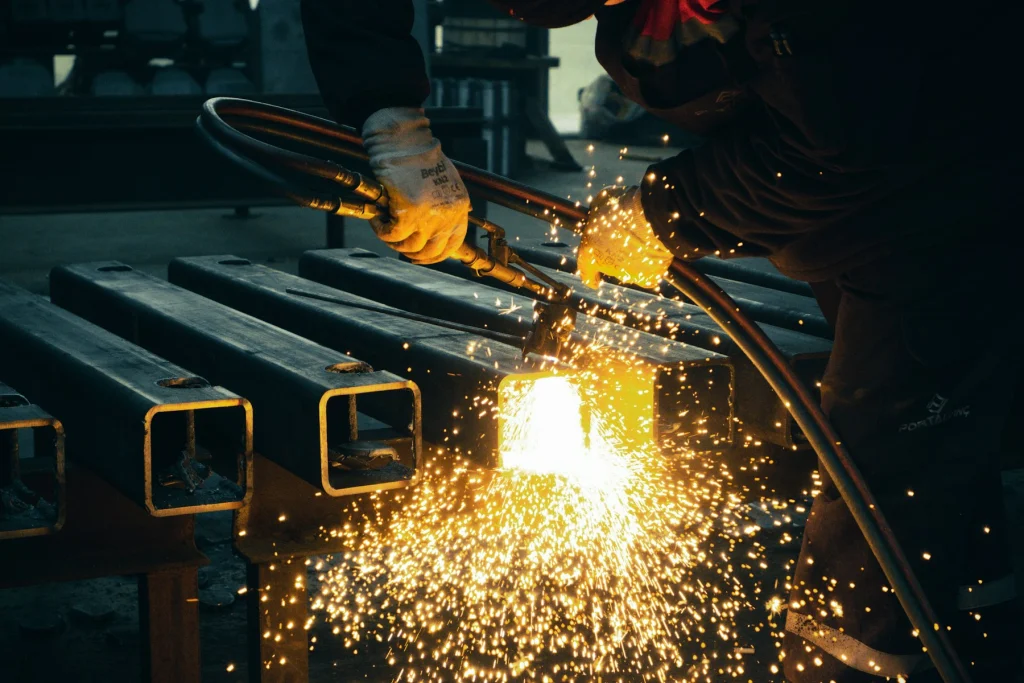

Good pipe fence welding starts long before the first bead. A ranch pipe fence lasts for decades when the line has braced corners, posts set deep in concrete, pipe sized for the stock it holds, and every rail joint coped and welded all the way around. Skip any of those and the fence starts failing at the welds.
Across Parker, Wise, Johnson and Tarrant counties, pipe fence is the standard for horse pastures, working pens, front entries and road frontage. It holds up to cattle leaning on it, handles the heat, and does not rot or need re-stretching like wire. But a pipe fence is only as good as its layout and its joints. We repair a lot of fence that was built fast, and the failures follow the same patterns every time. This guide covers what we have learned about building it right the first time, and what to look for if you are hiring someone to do it.
Key takeaways
- Plan corners, gate openings and braces first; the straight runs are the easy part.
- Used oilfield tubing and drill pipe are common and economical for ranch fence, but they need cleaning and inspection before welding.
- Coped (fish-mouth) or saddle-cut joints, fully welded, outlast butt joints and tack welds by a wide margin.
- Long continuous rails move with temperature. Plan for expansion on long runs, especially on road frontage that bakes in afternoon sun.
- Paint or coating is maintenance, not decoration. Bare pipe welds rust first.
How should a ranch pipe fence be laid out?
Walk the line before anything gets ordered. Mark corners, gate openings, low spots, creek crossings and any place the ground changes slope. Fence lines on rolling Cross Timbers country rarely run flat, and deciding how rails follow the grade is easier with flags in the ground than on a sketch.
Corners and braces carry the load
On a pipe fence the corner and end posts take the most stress, especially on pens where cattle crowd into a corner or push against a gate. Corners are usually a larger diameter or set deeper than line posts, and many builders add a diagonal brace or an H-brace to the first line post on each side. Gate posts deserve the same treatment, because a hanging gate puts a constant sideways pull on its post. A gate that sags in two years almost always traces back to an undersized or shallow hinge post, not to the gate itself.
Post spacing and rail count
Line post spacing on ranch pipe fence commonly falls somewhere around 8 to 10 feet, adjusted so panels come out even between corners and gates. Rail count depends on the stock: two or three rails may hold mature horses, while working pens for cattle often get four to six rails or a rail-and-cable or sucker rod combination so calves cannot slip through. Tighter spacing and more rails cost more steel and more welds, so match the design to what the fence actually has to hold.
Setting the posts
Most pipe fence posts are set in concrete. A common rule of thumb is to bury roughly a third of the post length, with corners and gate posts deeper still, but the clay soils around Fort Worth shrink and swell with wet and dry seasons, and that movement can heave or loosen shallow posts. Dig below the active layer where you can, bell the bottom of the hole if the soil allows, and crown the top of the concrete so water runs away from the pipe instead of pooling against it. Before any digging, call Texas811 so buried lines get marked; it is free and it is the law for excavation.
Gate openings and alleys
Size gate openings for the biggest thing that will pass through them, not just the pickup. A 12-foot opening feels generous until a hay trailer or a shredder has to swing through it on a turn. On working pens, think through how cattle will flow from the trap to the alley to the chute, and put gates where a single rider or a person on foot can work them. Moving a gate after the posts are set in concrete is far more work than drawing it in the right place on day one.
What pipe is best for ranch fence?
The right pipe depends on budget, the look you want and how much abuse the fence will take. Here are the common choices.
Used oilfield tubing and drill pipe
Recycled oilfield pipe is the backbone of Texas ranch fencing. Sizes like 2-3/8 inch and 2-7/8 inch outside diameter tubing are common for posts and rails, with heavier drill pipe sometimes used for corners and gate posts. It is strong, widely available and usually less expensive than new pipe of similar wall. The trade-offs are inconsistency and contamination. Used pipe can have mill scale, rust pits, paraffin, old coatings or internal plastic lining, and some joints have threaded collars or upset ends that need to be cut off or placed with care.
Before welding, we grind the joint area to bright metal and check the pipe for heavy pitting, thin spots and cracks. Internal coatings burn and smoke when heated, so we work upwind and keep fumes out of the welder’s face. Pipe with deep corrosion near the ends gets cut back to sound wall.
Sucker rod
Sucker rod, the solid steel rod used in oil well pumping, is often used for lower rails or infill between pipe rails. It is solid, stiff and cheap per foot, and it welds well. The catch is that some sucker rod is made from higher-strength alloy steel, which can crack if it is welded cold and quenched. Letting welds cool slowly and avoiding fast quenching keeps those joints sound.
New pipe and square tubing
New black pipe and square or rectangular tube give a cleaner, more uniform look, which is why they show up on entry fences and road frontage. They cost more per foot but take paint evenly and need less prep. Galvanized pipe resists rust but releases zinc fumes when welded, so the coating has to be ground back from the joint and the weld zone touched up afterward with a zinc-rich paint.
Which joints last longest on a pipe fence?
This is where most fence failures start. A rail that just sits on top of a post with a few tacks, or a line rail butted square against a post with a single pass, will crack under livestock pressure and heat cycling. These are the joints we use and recommend.
Saddle or fish-mouth joints on rails
When a line rail meets a post, the end of the rail is coped to the curve of the post, a cut often called a fish-mouth or saddle. That puts full contact between the pipes and gives a weld that wraps around the entire joint. It takes longer to cut than a square end, but the joint carries load through the whole circumference instead of a few spots.
Top rail over the posts
On a continuous top rail, posts are commonly cut to height and saddled so the rail sits down into the cut, then welded all the way around. Some builders cap each post and set the rail on top. Either works if the weld is complete. A post left open on top fills with rainwater and rusts from the inside out, so every open post end should be capped or covered by the rail.
Welding process and passes
Most ranch fence is welded with stick (often an E6010 root for penetration on dirty pipe, then E7018 or E6013 cover) or with self-shielded flux-core, because both shrug off wind. The goal is full fusion around the joint with no undercut at the toe of the weld, since undercut creates a notch where cracks start. One complete, well-fused pass on fence pipe is better than several cold, lumpy ones.
How do heat and weather affect a welded pipe fence?
Steel grows when it heats up. A useful figure to keep in mind is that carbon steel expands roughly 6.5 millionths of its length per degree Fahrenheit. That sounds tiny, but on a 300-foot continuous top rail, a 100-degree swing between a January morning and an August afternoon works out to more than two inches of movement. If that rail is welded rigidly to every post with no relief, something gives, usually a weld at a corner or a post that slowly gets pushed out of plumb.
- On long runs, break the continuous rail into sections with a small gap or a sleeved slip joint at intervals.
- Avoid locking a long straight run between two massive, rigid corners with no allowance for movement.
- Pay extra attention to road frontage and south-facing runs, which see the hottest steel.
Rain and humidity matter too. Bare welds and freshly ground steel rust first. A coat of primer and paint over the joints, renewed every few years, extends fence life considerably. Low spots where water stands against posts and fence lines along creeks deserve the closest inspection.
Paint and finish choices
Many ranch fences are left bare and allowed to weather, and that is a fair choice for back pastures. Where looks matter, or where the fence sits in wet ground, clean the pipe, hit the welds and any bare spots with a rust-inhibiting primer, then topcoat. Black, white and dark green are the common colors. Light colors show rust streaks sooner, while dark colors run hotter in the sun. Whatever you pick, the welds and the ground line are where coating fails first.
Repairing an existing pipe fence
Not every fence needs to be rebuilt. Most of the pipe fence calls we get through our gate and fence repair service are sections hit by a truck or tractor, rails broken loose by cattle, posts heaved by the clay, or gates sagging off their hinge posts. The usual fixes include:
- Cutting out bent or rusted sections and welding in new pipe with coped joints.
- Re-welding cracked rail joints after grinding out the old weld and any crack.
- Resetting or sleeving heaved posts, or adding a brace to stop a corner from leaning.
- Replacing undersized gate posts and re-hanging gates so they swing level.
Because the fence cannot come to a shop, this is classic mobile work. Our rig carries common tubing sizes, rod and a cutting torch, so many repairs are finished in a single visit. If you are still deciding whether your project is field or shop work, our post on mobile welding vs shop welding breaks down how to choose.
Pipe fence welding and planning checklist
- Walk the line and flag corners, gates, slope changes and water crossings.
- Decide what the fence must hold: horses, cows and calves, bulls, goats or just a boundary.
- Choose the pipe: used oilfield tubing, drill pipe for corners, sucker rod infill, or new pipe and tube.
- Set post spacing so panels come out even, and size corner and gate posts up.
- Call Texas811 before digging any post holes.
- Plan expansion breaks on long continuous rails.
- Cap every open post end.
- Budget for primer and paint on the joints, and a touch-up every few years.
- Note where gates go and what will pass through them, so openings are wide enough for trailers and equipment.
Frequently asked questions
How long does a welded pipe fence last?
A well-built pipe fence with deep posts, complete welds, capped posts and paint maintained over the years can last for decades. The parts that fail first are usually weld joints that were only tacked, posts set too shallow in shifting clay, and open post tops that rust from the inside. Inspecting and touching up the joints every few years makes the biggest difference in service life.
Is used drill pipe safe to use for fencing?
Used oilfield pipe is widely used for ranch fence and works well when it is sound. Inspect it for deep pitting, thin wall and cracks, cut off damaged ends, and clean welding areas to bare metal. Some pipe has internal coatings that smoke when heated, so weld with good ventilation and stay out of the fumes. Pipe from a reputable yard is usually graded by condition.
Should the top rail be continuous or cut between posts?
A continuous top rail looks clean and ties the fence together, but long runs need allowance for thermal expansion. Over a few hundred feet, steel can move a couple of inches between winter and summer. Breaking the rail into sections or adding slip joints at intervals prevents cracked welds and posts pushed out of plumb, especially on hot, sun-facing stretches.
Can you weld new pipe onto my old fence?
Yes. We regularly tie new sections into existing pipe fence. The old pipe has to be cut back to sound metal and cleaned to bright steel at the joint, and we match pipe diameter as closely as possible so the line looks consistent. If the existing posts are heaved or badly rusted at the ground line, we may recommend resetting or sleeving them first.
Do I need a permit to build a pipe fence?
Rural ranch fencing often does not require a permit, but rules vary. Fences inside city limits, in subdivisions with deed restrictions, along roads or near easements may have height, setback or material limits. Check with your city or county and any HOA before building, and always have buried utilities marked through Texas811 before digging post holes.
Planning a new line or patching an old one? Our ranch and farm welding crew builds and repairs pipe fence, pens and gates on your land, and our custom fabrication side handles matching entry gates and panels. Send photos, rough lengths and the property location through the Get a Quote form, and we will come back with a free written quote for your fence.