The choice between mobile welding vs shop welding comes down to one question: is it easier to move the steel or the welder? If the job is fixed in place, too heavy to haul or losing you money every idle day, bring the welder. If the part is small, portable and needs machining or paint, take it to a shop.
That sounds simple, and most of the time it is. But plenty of jobs around Fort Worth and the ranch country west of it land in the gray area: a gooseneck with a cracked tongue that can still roll, a set of pens that could be built in a shop and hauled out in sections, a loader bucket that could come off the tractor if you had the right trailer. This guide walks through how we think about those calls, what each approach does well, and where the costs actually come from, so you can decide before you start making phone calls or loading anything up.
Key takeaways
- Mobile welding wins when the work is fixed in place, very heavy, awkward to transport, or tied to downtime you cannot afford.
- Shop welding wins for small portable parts, precision fixture work, thin aluminum, machining, sandblasting and finish coatings.
- Hauling is never free. Count the truck, the trailer, the loading equipment, the fuel and the days without the item before you assume a shop is cheaper.
- Many good jobs are a hybrid: measure on-site, cut and prep ahead, then weld and fit in the field.
- A modern generator-powered rig carries stick, MIG and flux-core capability, a cutting torch and grinders, so most field repairs are not a compromise in weld quality.
What is the difference between mobile welding and shop welding?
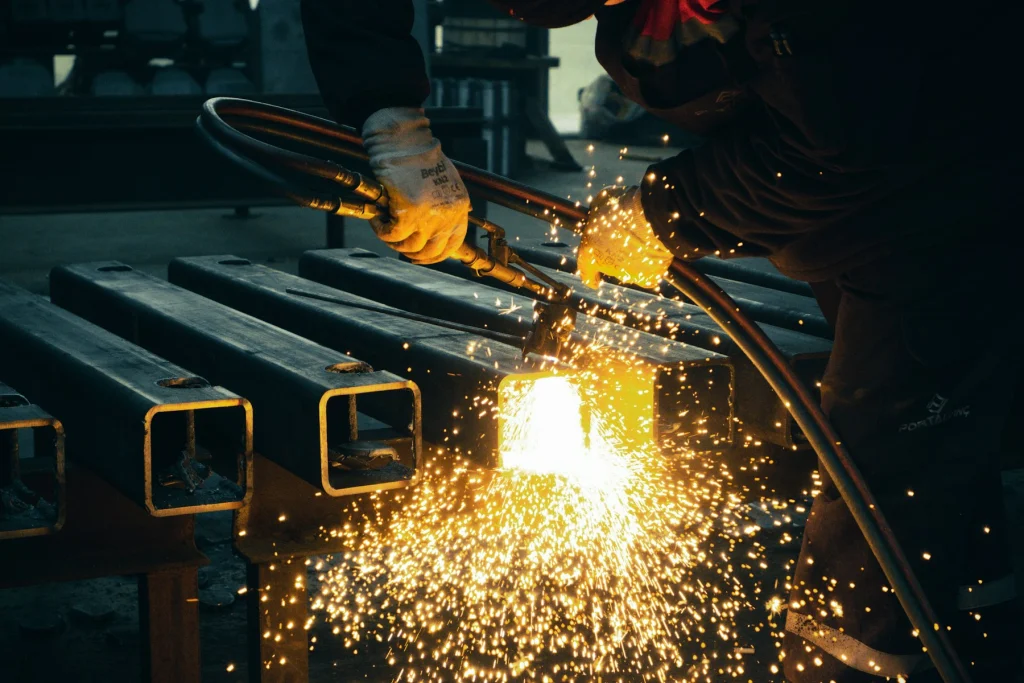
A welding shop is a fixed building with power from the utility, overhead lifting, big fixture tables, saws, drills, presses and usually a paint or blasting area. Parts come to the shop. The welder works under a roof, out of the wind, with every tool within a few steps. That controlled setting is the shop’s real advantage.
A mobile welder brings a truck-mounted rig to the work. On our truck that means an engine-driven welder that doubles as a generator, long welding leads, an oxy-fuel cutting torch, grinders, clamps, a stock of common steel shapes and the hand tools to cut, fit and finish on location. No hookup to your power is needed, which is why we can weld in a pasture two miles from the nearest outlet. Everything rides on one truck, so the shop shows up already stocked.
The processes are mostly the same
People sometimes assume field welding is a lesser grade of work. It is not, as long as the right process is matched to the conditions. Stick welding (SMAW) with rods like E6010 and E7018 handles wind, dirty steel and out-of-position joints better than almost anything, and it is the backbone of ranch and structural field work. Self-shielded flux-core (FCAW) lays metal down faster on heavier fence and frame work and does not need a gas bottle that the Texas wind will blow away. MIG with shielding gas and TIG are available too, but they shine indoors or behind a windbreak, which is one reason some thin-gauge and aluminum jobs still belong in a shop.
When does mobile welding make the most sense?
The clearest cases are the ones where moving the item is impossible or plainly foolish. Here are the jobs we see most often where bringing the rig is the obvious answer.
The steel is set in the ground or attached to a building
A pipe fence line, a set of corrals, a cattle guard, a gate post, a stair stringer, a canopy column or a mezzanine support is not going anywhere. These jobs are mobile by definition. Our gate and fence repair work and most ranch and farm welding happen exactly where the steel stands, because cutting it loose to haul it would do more damage than the original break.
The item is too heavy or too awkward to haul
Loader frames, skid steer attachments, backhoe booms, hay equipment and large trailers can technically be moved, but doing it may mean renting a lowboy, borrowing a tractor to load, chaining down an unstable load and losing a day each way. If the machine has a cracked frame, driving or dragging it to a shop can turn a manageable crack into a broken frame. Field equipment repair avoids loading a damaged machine at all.
Downtime is the real cost
A stock trailer you need Saturday, a skid steer on a job with a crew waiting, or a broken pen gate during working season costs far more in lost time than the weld itself. Shops run a queue. If your trailer goes in on Monday, it may not get looked at until the jobs ahead of it are done. A mobile visit is scheduled for your site and your item, and when we pull out, the repair is finished.
The repair needs to be fitted in place
Some work only makes sense when you can see how it sits in the real world: a gate that has to swing true on posts that have settled, a ramp that has to land on a specific dock, a bracket that has to line up with existing bolt holes. Fitting and tacking in place, then welding out, gives a better result than building to a tape measure in a shop forty miles away.
When is shop welding the better choice?
We send people to shops, or bring work back to a bench, when that is what the job needs. Being honest about it saves everyone time.
- Small, portable parts. A broken bracket, a mower deck spindle mount or a trailer jack plate that fits in a pickup bed can usually go to a shop without much hassle.
- Thin aluminum and stainless that need TIG. Gas-shielded TIG on thin material wants still air and a clean bench. We can screen a work area outdoors, but a shop is often the better environment for cosmetic thin-wall work.
- Machining and line boring. Worn pin bores, shaft repairs and anything that needs a lathe or mill after welding belong in a machine shop.
- Finish coatings. Sandblasting, powder coat and hot-dip galvanizing happen at fixed facilities. A part headed for galvanizing has to go there anyway.
- Repetitive production. Twenty identical brackets are faster with a jig on a shop table than one at a time on a tailgate.
How much does mobile welding cost compared with a shop?
We will not quote numbers in a blog post, because prices depend on too many variables to be useful out of context. What we can do is lay out the cost drivers on both sides so you can compare apples to apples.
What drives the cost of a mobile welding visit
- Travel and setup. Distance from our route, road conditions and how close the truck can park to the work.
- Time on the job. Cutting out damaged steel, fitting new pieces and welding out. Prep often takes longer than the welding itself.
- Materials. Pipe, plate, angle, channel or tube, plus rod, wire and gas. Common sizes ride on the truck; special stock adds a supply run.
- Access and conditions. Overhead work, tight spaces, mud and safety requirements on commercial sites all add time.
The hidden costs of taking it to a shop
- A truck and trailer rated for the load, plus fuel for two round trips.
- Equipment and people to load and unload, and the risk of damage during transport.
- Disassembly and reassembly, such as pulling a bucket, unbolting a gate or removing a ramp.
- The days the item is gone, waiting in the shop queue.
When people add up that second list honestly, the shop’s lower hourly rate often stops looking like a saving. On the other hand, if the part rides in your truck and the shop is on your way to town, the shop may well be the cheaper call, and we will tell you so.
Can a mobile welder do structural or code work?
Yes, with the right preparation. Structural field welding on columns, beams, base plates and supports is routine for mobile rigs, and on commercial jobs the engineer of record or general contractor usually specifies the procedure, electrode and inspection requirements. Work tied to building codes or an engineered design should follow those documents, and permit questions should go to the local building department. Our structural and commercial welding page covers how we coordinate with contractors on that kind of work.
Where a shop does have an edge is in work that needs certified procedures qualified on specific fixtures, or parts that must be welded in a controlled position and then inspected before shipping. In those cases the shop builds and the field crew installs.
The hybrid approach: measure in the field, build smart, finish on-site
Some of the best results come from splitting the work. On a new set of pens or a custom gate, we measure and photograph on the first visit, cut and prep parts ahead of time, and then return to fit and weld in place. That keeps time on your property short while still getting a fit that matches the actual posts and ground. Our custom fabrication projects often run this way.
The same idea works in reverse. If a loader frame needs a crack repair in the field but the worn pivot bores also need machining, we can do the structural weld on-site and you can send the pins and bushings out for machine work, without hauling the whole machine anywhere.
Mobile welding vs shop welding: a quick checklist
Run through these questions before you call anyone. If you answer yes to two or more in the first group, mobile welding is probably the better fit.
Points toward mobile
- Is the item set in concrete, buried, bolted to a structure or part of a fence line?
- Would moving it require a trailer, a loader or more than one person?
- Is it damaged in a way that transport could make worse?
- Does every day without it cost you work, animals, crew time or a contract deadline?
- Does the repair need to be fitted to existing posts, hinges, docks or bolt patterns?
Points toward a shop
- Does the part fit in a pickup bed and come off without special tools?
- Does it need machining, line boring, blasting, powder coat or galvanizing?
- Is it thin aluminum or cosmetic stainless that needs still air and TIG?
- Are you making many identical pieces?
If you are unsure, send us photos. We would rather tell you up front that a shop is the right answer than drive out for a job that belongs on a bench. And if your site needs some preparation before we arrive, our guide on getting your property ready for a mobile welder walks through access, safety and what to have on hand.
Frequently asked questions
Is mobile welding as strong as shop welding?
Weld strength comes from the process, the filler metal, the joint prep and the welder’s skill, not from the building. Stick and flux-core welds made in the field with proper prep are just as sound as shop welds. The main field challenge is wind blowing away shielding gas, which is why we lean on stick and self-shielded flux-core outdoors and save gas-shielded processes for sheltered spots.
Do I need to provide electricity for a mobile welder?
No. Our rig carries an engine-driven welder that also produces power for grinders and lights, so we can work in an open pasture, on a gravel lot or at a site with no service yet. What helps is a reasonable place to park the truck within reach of the work and a clear, safe path for the leads.
What kinds of jobs should never go to a shop?
Anything set in the ground or attached to a structure, such as fence lines, gate posts, cattle guards, stairs and building supports. Machines with cracked frames are another, because loading and hauling a cracked frame can spread the crack. For those, field repair is both safer and usually less disruptive than any attempt to move the item.
Can you weld aluminum on-site?
Often, yes. Aluminum trailers, ramps and toolboxes can be repaired in the field with the right equipment and a sheltered work area. Very thin or cosmetic aluminum work, or parts with heat-treated alloys that the manufacturer says should not be welded, may be better handled in a shop or replaced. We will tell you which applies after we see photos.
How do I know whether my job is mobile or shop work?
Send photos, a short description and the location through our quote form. We look at size, weight, access, materials and whether the repair needs machining or coatings. If it is a field job, we schedule a visit. If a shop would serve you better, we say so plainly and explain why, so you are not paying for a trip you do not need.
Still weighing it up? Tell us what is broken and where it sits. Use the Get a Quote form to send a few photos and the job location, and we will reply with a free written quote or an honest recommendation if a shop is the better fit. Either way, you will know your options before anything gets loaded on a trailer.