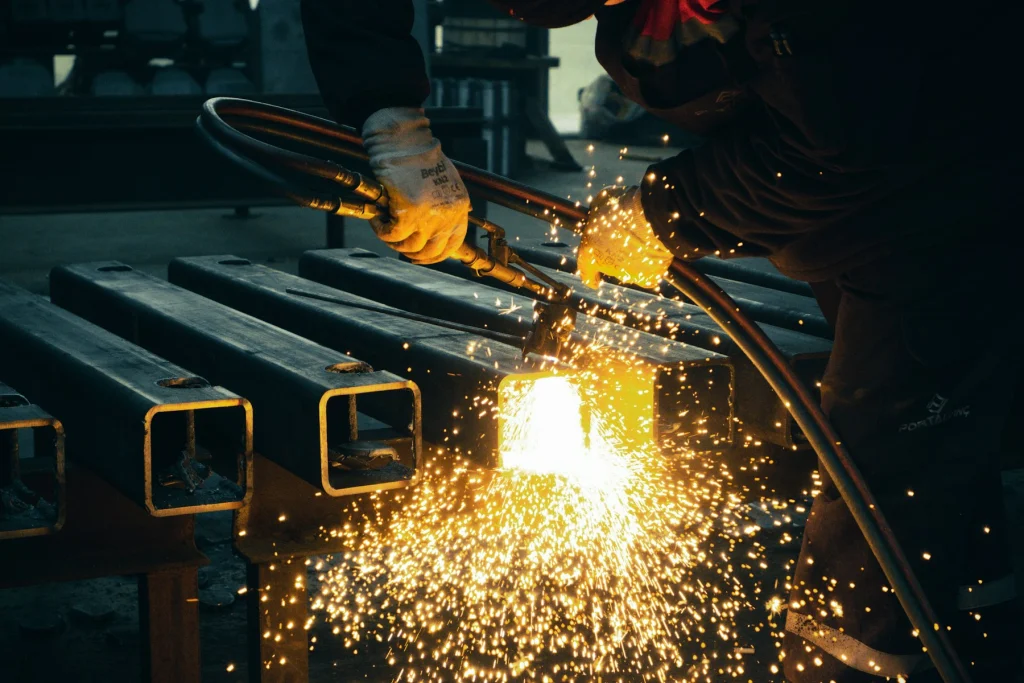
Livestock trailer repair usually comes down to three areas: the floor, the crossmembers that hold the floor up, and the hitch that ties the whole load to your truck. Manure, urine and trapped moisture rot floors and eat crossmembers from underneath, while hauling stress cracks hitch and tongue welds. Catch those early and most trailers can be repaired in place.
A stock trailer takes more abuse than almost anything else on a ranch. It hauls a shifting live load over washboard county roads, sits in the weather between uses, and gets hosed out, or not, after every trip. Around Fort Worth, where trailers go from summer heat to wet winters and back, corrosion and fatigue tend to show up in the same places on nearly every make. This guide explains what fails, why it fails, and what a proper repair looks like, so you can spot trouble before it becomes a roadside problem with animals on board.
Key takeaways
- Floor rot and crossmember rust start underneath, where you cannot see them. Get under the trailer at least twice a year.
- Rubber mats protect hooves but trap urine and moisture against the floor. Pull them and let the floor dry.
- Crossmembers usually fail where they meet the main frame rail, not in the middle.
- Hitch, coupler and gooseneck welds are safety-critical. Cracks there mean the trailer stays parked until it is repaired.
- Aluminum trailers can be repaired, but they need different processes and more care than steel.
How a stock trailer is built, and where it takes the stress
Most bumper-pull and gooseneck stock trailers share the same basic layout. Two main frame rails run front to back. Crossmembers, usually C-channel, tube or angle, run side to side between those rails every foot or two and carry the floor. The floor itself may be treated wood planks, steel plate, or extruded aluminum boards on an aluminum trailer. Up front, the tongue or gooseneck connects the frame to a coupler or ball receiver that rides on your truck.
Every pound of livestock travels down through the floor into the crossmembers, out to the frame rails, and then forward through the tongue or neck to the hitch. When animals shift on a turn, or the trailer bounces through a cattle guard, those loads spike. Welds at each connection, crossmember to rail, rail to neck, neck to coupler, see repeated stress cycles every trip. That is why fatigue cracks show up at connections, not in the middle of a straight piece of steel.
Why do livestock trailer floors fail?
Manure and urine are corrosive
Urine breaks down into ammonia compounds, and manure holds moisture and salts. Left on a floor, the mix soaks into wood and sits against steel and aluminum, speeding up corrosion on everything it touches. Wood planks soften and split, especially at the ends where they sit on crossmembers and along the edges where they meet the side walls. Steel plate floors pit and thin from the top down.
Mats trap the moisture
Rubber mats give animals footing and cushion, and they are worth having. But a mat that never comes out keeps the floor beneath it permanently damp. We regularly see trailers where the mats look fine and the wood underneath has turned to mush. Pull the mats after hauling, wash the floor, and let it dry fully before putting them back.
Repairing or replacing the floor
Wood floor replacement is mostly carpentry, but it is the right time for welding work, because pulling the boards exposes every crossmember and the inside face of the frame rails. That is when we cut out rusted crossmembers, weld in new ones, and fix any cracked connections before new boards go down. On steel plate floors, thin or rusted-through areas are cut out and new plate is welded in, with the seams supported over a crossmember. Sealing and painting the underside before reinstalling anything adds years.
What should you look for on trailer crossmembers?
Crawl under the trailer with a flashlight and a screwdriver or a small hammer. Here is what tells you a crossmember needs attention.
- Heavy scale or flaking rust where the crossmember meets the frame rail. That joint holds moisture and debris.
- Holes or soft spots when you tap the bottom flange. Sound steel rings; rotten steel thuds or pokes through.
- Sagging in the floor between rails, which often means a crossmember has bent or cracked loose at one end.
- Cracked welds at the ends, sometimes visible as a thin rust line where the weld has separated from the rail.
- Bent members from a hard load or a high-centered trailer.
The fix is to cut out the damaged crossmember, clean the frame rail back to sound steel, fit a new member of the same or heavier section, and weld both ends fully. Where the frame rail itself has thinned at the joint, we add a gusset or reinforcing plate. Replacing one bad crossmember while its neighbors are nearly as rotten only buys time, so we usually look at the whole row and tell you honestly how many are worth saving.
Hitch, tongue and gooseneck welds explained
This is the part of livestock trailer repair you cannot put off. A failed floor board is an inconvenience. A failed coupler weld on the highway is a disaster.
Bumper-pull tongues and couplers
On a bumper-pull trailer, the tongue channels or tubes run forward from the frame and meet at the coupler. Cracks tend to show up at the coupler weld, where the tongue meets the front crossmember, and at the safety chain attachment points. Some couplers are bolted, some are welded, and some trailer and coupler manufacturers specify which repairs they allow. We follow those specifications, and where a coupler is worn or cracked we usually recommend replacing it with a properly rated unit rather than welding over a crack in a forged part.
Gooseneck necks and ball receivers
Goosenecks carry heavier loads and put a long lever arm between the hitch and the frame. Cracks appear where the neck meets the main frame, at the bend in the neck, and around the ball coupler housing. Repairing a gooseneck neck means grinding out the crack completely, checking that it has not run further than it looks, welding it back with full penetration, and often adding reinforcement plates designed so they do not create a new hard spot where stress concentrates. Tapered or diamond-shaped plate ends spread load better than square-cut plates.
Safety chains and jack mounts
Safety chain loops and jack mounts are welded attachments that can crack or wear thin. Chains should attach at points strong enough to hold the trailer if the coupler lets go. Jack mounts that wobble or show cracked welds should be repaired before the jack drops the trailer during hookup.
Spring hangers, equalizers and gates
On leaf-spring axles, the hangers and equalizer brackets are welded to the frame and take a beating every time a wheel drops into a pothole. Worn bushings let the spring eye hammer the hanger, and cracks follow. Re-welding a cracked hanger without replacing worn bolts and bushings just starts the cycle again, so we look at the whole suspension mount, not just the crack.
Rear and center gates are the other high-wear area. Hinges wear oval, gate frames crack at the hinge knuckles, and slam latches bend after years of cattle hitting them. These repairs are small, but a gate that swings free on the road or will not latch at the sale barn is a real problem. Rebuilding hinge pins and knuckles and straightening the gate frame usually puts things right in one visit.
Things a welder should never do on your trailer
A careful repair is as much about what you avoid as what you weld. Here are the rules we follow on every trailer.
- No welding on torsion axle tubes. Torsion axles have rubber cords inside the tube. Heat from welding damages them, and the axle has to be replaced. Brackets and mounts get bolted or welded only where the axle manufacturer allows.
- No welding near brake lines, wiring or tires without protection. We pull back or shield wiring harnesses, brake lines and hoses, and keep spatter off tires.
- Disconnect the battery. Trailers with electric brakes have a breakaway battery. We disconnect it and the truck before welding so current does not travel through the electrical system.
- Ground close to the weld. The ground clamp goes right next to the repair so welding current does not pass through wheel bearings, hinges or the hitch ball.
- Do not weld over rust or paint. Every joint gets ground to bright metal first. Welding over scale traps contamination and makes a weak, porous weld.
Steel vs aluminum stock trailers
Steel trailers are the easier repair. Mild steel frames weld readily with stick, MIG or flux-core, and repairs can match or exceed the original strength.
Aluminum stock trailers resist rust but come with their own considerations. Aluminum conducts heat quickly, needs very clean surfaces, and is welded with MIG using a spool gun or push-pull setup, or with TIG. Many trailer frames are built from heat-treated alloys such as 6061, and welding reduces the strength of the metal right next to the weld. Good repairs account for that with proper joint design and reinforcement where needed. Aluminum also cracks around stress points and fastener holes, and some manufacturers publish specific repair guidance. We follow it when it exists.
Mixed trailers, steel frames with aluminum skins or vice versa, need attention where the two metals touch. Moisture between dissimilar metals causes galvanic corrosion, which is why isolating tape or coatings matter during reassembly.
Livestock trailer repair and inspection checklist
Run through this list at least twice a year, and before any long haul.
- Pull the mats, wash the floor, and probe boards or plate for soft spots and holes.
- Get underneath and tap each crossmember, especially at the ends where they meet the frame rails.
- Look for rust lines along weld seams, which often mark a crack.
- Inspect the coupler or gooseneck ball housing, the tongue or neck, and the junction with the main frame.
- Check safety chain attachments and the jack mount for cracks or wobble.
- Look at spring hangers and equalizers on leaf-spring axles for worn or cracked welds.
- Test brakes, lights and the breakaway system.
- Check gates, latches and slam latches; a gate that will not latch is an escape waiting to happen.
- Touch up bare steel with primer and paint before rust takes hold.
Frequently asked questions
Can a livestock trailer be repaired where it is parked?
Most of the time, yes. Crossmember replacement, floor plate repair, tongue and gooseneck crack repair, gate and latch work and hinge repair can all be done on-site with a mobile rig. We need room to get under the trailer and a reasonably level spot. If the trailer needs to be lifted, a pair of jack stands rated for the weight is helpful.
Is it safe to weld a cracked trailer hitch?
It depends on what cracked. Cracks in the tongue, neck or the welds around the coupler can usually be ground out and properly repaired. A crack in a forged coupler, ball or other manufactured hitch component is a different matter, and the safe answer is usually replacement with a rated part. Until the hitch is repaired or replaced, the trailer should not haul.
How often should I replace my trailer floor?
There is no set interval. A treated wood floor that is cleaned out after use and allowed to dry can last many seasons, while one that stays under wet mats can rot in a few. Inspect it twice a year, probe for soft spots, and replace boards as soon as they lose strength. When the floor comes out, it is the best time to check crossmembers.
Can you weld an aluminum stock trailer?
Yes, aluminum stock trailers can be repaired, though the process differs from steel. It takes very clean metal, MIG with a spool gun or TIG, and attention to the strength loss heat causes in heat-treated alloys. Some manufacturers publish repair guidance, and we follow it. Severely cracked or corroded aluminum structure sometimes makes more sense to replace than to patch.
What causes crossmembers to rust out first?
Crossmembers sit under the floor, right where wash water, urine and manure drain and collect. The joint between the crossmember and the frame rail traps debris and stays damp, so corrosion starts there and works inward. Trailers parked on grass or dirt also stay damp underneath longer than ones parked on gravel or concrete, which speeds up the process.
We handle stock, utility, flatbed and equipment trailers through our trailer repair service, and we bring the rig to your barn, pasture or yard. If the trailer is part of a bigger list, our ranch and farm welding visits can cover pens, gates and the trailer in one trip, and our guide to preparing your property for a mobile welder explains how to set things up. For cracked loaders and implements, see our notes on field repairs on farm equipment. Send photos of the damage and the trailer’s location through the Get a Quote form, and we will reply with a free written quote.